
![[personal profile]](https://www.dreamwidth.org/img/silk/identity/user.png)


gamma proposal
**I have no idea what to call the city, so let's go with the working name 'Arkham.' It's not... actually Arkham, sorry to people who know the lore. This is almost entirely just brainstorming on my part, and will have to be polished.**
CREDIT: Tons of this is mechanically drawn from and inspired by Arkham Horror and the Call of Cthulhu tabletop! I don't own either, and none of this will ever be used for profit. Most of the art is also from Arkham Horror, with one Bioshock concept; other artists include Nathan Rosario, Scott Purdy, and Patrick McEvoy. Additionally, thanks to Theresa for reading over this mess for me and giving me some ideas!
Gamma Phase Location Worksheet

Hook
IT'S A GOOD TIME TO BE ALIVE.
The Roaring Twenties promise jazz, speakeasies, and copious art deco— from boat to bustling city. What could be better? But behind the bright lights and booze, there's whispers of something stranger, in languages better left long-dead. Themes and Goals
- " We live on a placid island of ignorance in the midst of black seas of
infinity, and it was not meant that we should voyage far. "
What is Lovecraftian horror?
H.P. Lovecraft and the many talented writers that helped craft the mythos as we know it today were fans of horror on a cosmic scale. Gods and monsters that were so beyond humankind's comprehension that trying to understand— or even look at— them could drive a man to the edge of insanity. He emphasized the fragility of the human psyche, and in that there's a pervasive sense of hopelessness to all his tales: 'hero' or 'villain' alike usually end up dead, insane, or monstrous in their own way. The infamous Elder Gods? Don't even care. Any malevolence on their part may as well be incidental (with exceptions).
Humanity is, quite literally, dust in the cosmic winds.
Lovecraft-inspired horror and media includes Amnesia: The Dark Descent, Eternal Darkness, Hellboy, and The Thing, amongst many others.

" You ain't heard nothin' yet. "
What makes the Roaring 20s?
The Roaring Twenties define post-World War I culture. It's a decade immediately identifiable by its art and energy and image (and at times, excess): flappers and fashion, the rise of cinema and the gangster image. It's a beautiful era, if a bit foreboding when you know what happens in the 30s.
Coincidentally! Lovecraft's stories generally take place during this period. And while he preferred quiet, rural locations, there's plenty to take out of the cityscape too.
The goals are not so different from now: destroy COMPASS, stay alive, and get home. In fact, the city lights are almost inviting.
But all good things come to an end. Arkham is drowning in the supernatural; it draws the attention of forces it really, really shouldn't, and it's a veritable hotspot for monsters. Sometimes, they're simple. Ghosts, zombies, vampires, were-everythings. Other times? Not so much. Maybe it'll be an eight-foot, inside-out humanoid whose stare makes your skin itch uncontrollably (until you scratch it all off, of course). Or a 'hound' that lives in the very angles of time, stalking you through all of space and dream.
That's not to say monsters are the only threat around. Arkham's huge cult presence will often shake the city: stealing people away in the night, performing rituals that set off a wave of paranoia, waking up the mummies at the local museum, et cetera. They're destructive, misguided (at best) people, and will happily unleash horrors greater than they can imagine if left to their own devices.
The key is that, despite whatever it may seem like on the surface, staying in Arkham will be testing characters' wills, often pushing them to the brink of death and forcing them to make sacrifices. Or worse— drive them insane.
Because who knows who they'll take down with them if that happens.
Setting
- Overall

Arkham is just what one might expect from a lively city: a living, bustling heart of culture, with signs of grime and shady alley dealings. Further out from the city's core, there's more breathing room and isolated buildings, and past that is the beginning of a sprawling countryside, dotted by forests and abandoned farms. It doesn't have the same sense of claustrophobia or drought of supplies like the Charon, though towards the city's central square there isn't much room to maneuver.
The temperature/climate on a good day is nothing worth talking about. Think nondescript northeastern city. However, the weather does get weird from time to time; on one hand, there may be icy rain in the middle of summer, or a sweltering drought for Christmas. But when things get really hectic, there might be a sandstorm, or it may start raining frogs, or maybe the sun and stars will seem lower in the sky, and everyone's magic goes out of control. So in general, there won't be any constant fears to worry about in the environment, but nature can be just as fickle and vicious as everything else in Arkham.
The buildings seem strangely resilient to harm, and repairs work incredibly (unnaturally) fast. On the flip-side, the further from the city's core, the more run-down everything is— the outskirts are overgrown, and the old-fashioned buildings can be dangerously dilapidated. Initially, players will be encouraged to explore the city and all its various establishments. These could include diners, bars, inns, and general stores, to odd antique stores that carry more magical items, and a pawn shop that would allow people to grab supplies from home. As they get situated, events will likely take them to more isolated locations (the harbor, old mansions, et cetera), and occasionally the train station will allow them access to other towns.
Base Camp
 A couple options are available here. While the Charon definitely emphasized a cramped setting, where everyone would be forced to work together, the characters in Arkham will often be more alienated.
But to avoid having characters never run into each other, the city's center will be extremely dense, and relatively small. One choice would be that everyone is housed at the local university, and trying to live anywhere else will result in the city residents chasing them out. Or all the characters could be placed in one apartment complex/slum, just for lack of space elsewhere. The former would have something akin to Miskatonic University as their 'home base,' and would have most of what one might expect for a small-sized college. The latter would be a little simpler to manage, but have less room to maneuver during times of crisis. The slums would also allow for a large amount of customization, as no one gives a damn what happens to them, but the refugees will not be able to build any additional whole buildings. They'll have to work together to improve what they have. In either situation, the living conditions are cramped and spartan, with far too many people assigned to each room.
While housing will be limited, businesses can be taken over from the natives as is reasonable. Should someone start acting like the owner of an establishment, the original citizens will adjust almost immediately, and life for them will go on as though nothing's changed.
Life and the Living
Natives
- The 'original' residents of the city are an odd, mostly useless bunch. Any efforts to speak to them seem scripted, conversations that go in loops— and when times get tough, they all but disappear. They're mostly background noise. The dancers in a club, passerbys on the street, the obnoxiously unhelpful bank teller, et cetera. The police will arrest anyone who causes too much trouble, but the bail is reasonable enough, and they have very blasé attitudes to any perceived supernatural shenanigans.
There are a few exceptions, however. The cults will be aware of the presence of the PCs, as will key, important figures on both ends of the morality spectrum (see: NPCs).
NPCs
- Ideas include:
✱ Helpful NPCs. A crotchety scholar, a reformed cultist, a witch, whatever else.
✱ COMPASS NPCs, aka jerks. This would likely include cult leaders, the mayor, sorcerers with a little too much hubris, and whoever else could actively make everyone's lives miserable.
✱ Avatars and heralds of the Elder/Outer Gods. Might be mixed with COMPASS. Either way, they'll most likely poke and prod the passengers with bouts of insanity and other such wonderful gifts, just because. Again, once you get to this level of power, they really don't care about active malevolence. One idea I'd like to explore is some force that can give blessings or powers to those that seek it out, but none of it comes without a price.
✱ Benevolent gods that occasionally reward players are also an option, like Bast. They will probably play a far less significant role if included at all.
✱ Gangs will be prevalent, acting as both a boon and a curse, as they have no sense of loyalty, but will often by the only means to get shadier supplies.
(i have some other ideas but i think they would be spoilers to talk about if this setting actually got picked)
Given the survival rate in most Lovecraft stories, one can expect that the NPCs all bear the risk of dying horribly (besides the immortal ones, and even then who knows for sure).
Monsters and Wildlife
 This mythos and all its spinoffs has a huge amount of monsters to draw from. Previously mentioned is one of the most famous (the Hounds of Tindalos, which can materialize seemingly out of thin air wherever there's a sharp angle), but there is practically no end to the Lovecraftian bestiary. Additionally, there are Elder Gods (Cthulhu being the most popular example), who can be called upon to wreak larger, city-wide havoc. We're also not strictly limited to Lovecraft lore; anything that fits the general themes of the game could be a possibility.
To give a little more insight on what these monsters are like:
- ✱ Byakhee are huge, flying creatures, which look roughly like a mish-mash of decomposed creatures. They are violent while feeding, but can be summoned by people brave (or dumb) enough to explore dark magic, in which they can be ridden like steeds. Which is really also not recommend either.

✱ Dimensional Shamblers look vaguely like apes, with claws. Anything (or any part of a thing) that it gets a hold of, it can transport to another dimension. This, unfortunately, includes people.

✱ Mi-go are alien, bug-like creatures which are actually fungi, and much smarter than their appearance would suggest. They are capable of human speech, and advanced surgeries; they're a curious bunch, which a bad habit of stealing human brains to put in tubes and talk with.
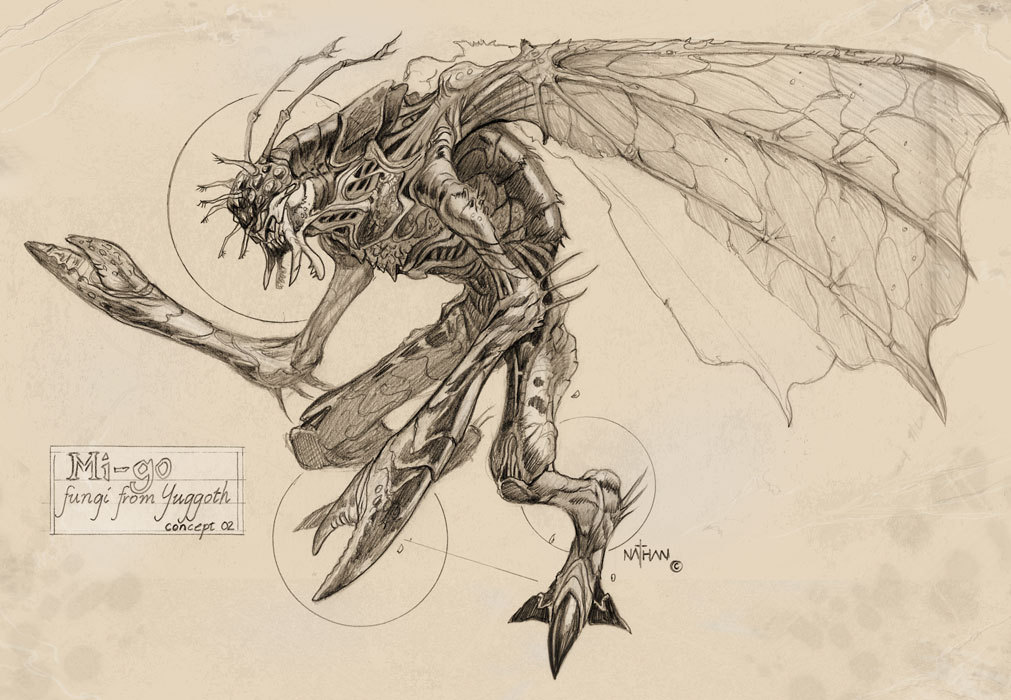
Some examples of what could be seen, given that they are in some way inspired by Lovecraft/fit in with the setting's themes:
- ✱ Reapers from Mass Effect, which are heavily based on Lovecraftian lore. Effectively dreadnoughts, these huge, technological 'monsters' are capable of razing a city with little to no effort. Even a dead Reaper can be a threat via indoctrination, which slowly, subtly works to abuse a subject's paranoia and eventually brainwashes them completely.
✱ Xenomorphs of the Alien franchise also add more of a sci-fi element, but are frightening, capable creatures, "unclouded by conscience, remorse, or delusions of morality." Chestbursters and facehuggers are standard, of course.
✱ The Thing, which is a shape-shifting creature that can almost perfectly emulate anyone it assimilates. The grotesque nature of its kills are bad, but worse is the paranoia— how can you trust other people, when anyone could be The Thing?
More natural wildlife will be largely absent, as the majority of the setting is urban. Not to the level of cities as they are now (at the edge of the city limits, there will be more room for nature, creepy houses, and whatnot), but still not much in the way of traditional flora/fauna.
The far outskirts of the city will seem still during the day. But it'll be teeming with monsters, and no one would be able to survive the night.
Gameplay
Game Mechanics
- As stated, there is no escaping Arkham— there's nothing to stop the characters from trying, but they will always be killed in the most gruesome manner possible. 'Docking' events are here to stay as well (see: Possible Events).
Occasionally, the local train station may stop being broken, and characters may have to visit other local towns to find new clues and allies. And as the cults in power cycle and bicker, different groups will come to hold the reigns, each influenced by their own God and shaping the town in their image. For those who are used to less proper means to an end, there will also be an opportunity to interact with the local gangs and bootleggers, who can be allies or enemies, depending on how they're treated by the refugees. Either way, crime will help or hinder the players, and in this era, is completely unavoidable.
Unlike Beta, living in civilization again means currency exists. All characters would receive a small allowance in the form of unique coins; soup, water, and housing is free, but everything beyond that will require some compensation. With enough coins, a character may be able to buy items from home at the suspicious pawn shop in town, pay off the local smugglers for illegal weapons or artifacts, buy 'luxury' items, movie tickets, booze (let's remember the Prohibition is going on), and whatever else. This is the only form of cash the NPCs of Arkham will accept, and once the coins are spent, they're gone for good. Attempting to rob one of the citizens will result in empty wallets, or the equivalent of Monopoly money. Though naturally, there's nothing stopping the characters from mugging each other.
Devices will be like the current compass, with a little more heft and visual pizzazz, maybe with an additional radio add-on to replace the earpiece's emergency contact capabilities. Since technology in this period is lacking, the translation items will probably be a bit more 'magical' in nature, like an enchanted, period-appropriate accessory.
Speaking of magic, it's very, very real in this world. So much so that mages may find new spells to learn, and people may be able to tap into sources of power and knowledge they hadn't had the opportunity to before. These will provide obvious short-term benefits, but in time, will come with a cost. The magical nature of the world may also be why death isn't permanent, and why people wake up in the asylum 24 hours later. And also why they don't quite feel whole afterward.
Possible Events
- Arkham has the dimensional stability equivalent to wet tissue, which explains why it attracts so many monsters and cultists trying to summon Eldritch abominations through time and space. What this also means is that occasionally, portals to other (canon) worlds will open. Much like the docking events now, these portals will offer a chance for a change of scenery, events, and inventory for the characters to stock up on.
While not strictly mandatory, characters can be sucked in or explore voluntarily. The portals will be one-way until a set amount of time passes/an objective is completed; however, people and creatures from the 'invading' world will not be limited as such. So it may be in everyone's best interest to try and close it. Leaving a gaping dimensional rift in the middle of town's square may also be kind a risk in terms of universal stability too, but who knows for sure.
Other event examples have been mentioned throughout this proposal, but to briefly summarize: this might include Lovecraftian-themed monsters, problems caused by the varying and numerous local cults, volatile magic and the occult causing problems with the weather/populace/everyone's mental states/etc, NPCs with deals too good to be true, and occasionally something more absurd and inexplicable than frightening: swapping brains or a visit to the Dreamlands and the like.
Direction

" This city's hiding something. "
But you know— Arkham's where all the fun is. I don't think I could bring myself to leave.
The characters are once again dragged along by COMPASS, who will have its hands in all the affairs as per usual. The city's story will be moved forward by players who want to find out the mysteries of this place, in an effort to escape, or learn more about their captors, or for just plain, simple revenge. But the crime rings, the corrupt government, and the cults will take notice when the power shifts, when people start asking too many questions. The closer they get to any answers, the more dangerous it is to keep poking around. Defeating the COMPASS representatives in the cults/The Mayor will reveal more and more with time, and the city will throw trial after trial at the refugees in turn.
Of course, not fighting and trying to revel in whatever luxury they can afford, is an option. Why take that strange train to Innsmouth, or investigate that creepy abandoned church outside the city, or jump through the mysterious portal? No fun to be had there. And that's fine, for a while. But there's something going on under the depths, and it's not going to leave any survivors, no matter how ignorant they choose to be.